
Assets

iPulse AI Editorial Picks research

Best Energy Stocks

Explore the best energy stocks across the governed oil-and-gas, refining, pipeline, power-generation, renewable-energy, and energy-equipment and services universe. iPulse AI combines one-year return potential with five-year trend confirmation, multi-agent consensus, business quality, financial health, valuation, and risk resilience. The review also tests commodity-price exposure, project economics, capital discipline, regulation, energy-transition risk, and cash-flow durability. Every selection includes a clear thesis, projected returns, catalysts, and the risks that could change the outlook.

Explore overall iPulse AI portfolio strategies and performance

Editorial ApproverRusslan Ramdowar iPulse AI Engine V6 15 min read
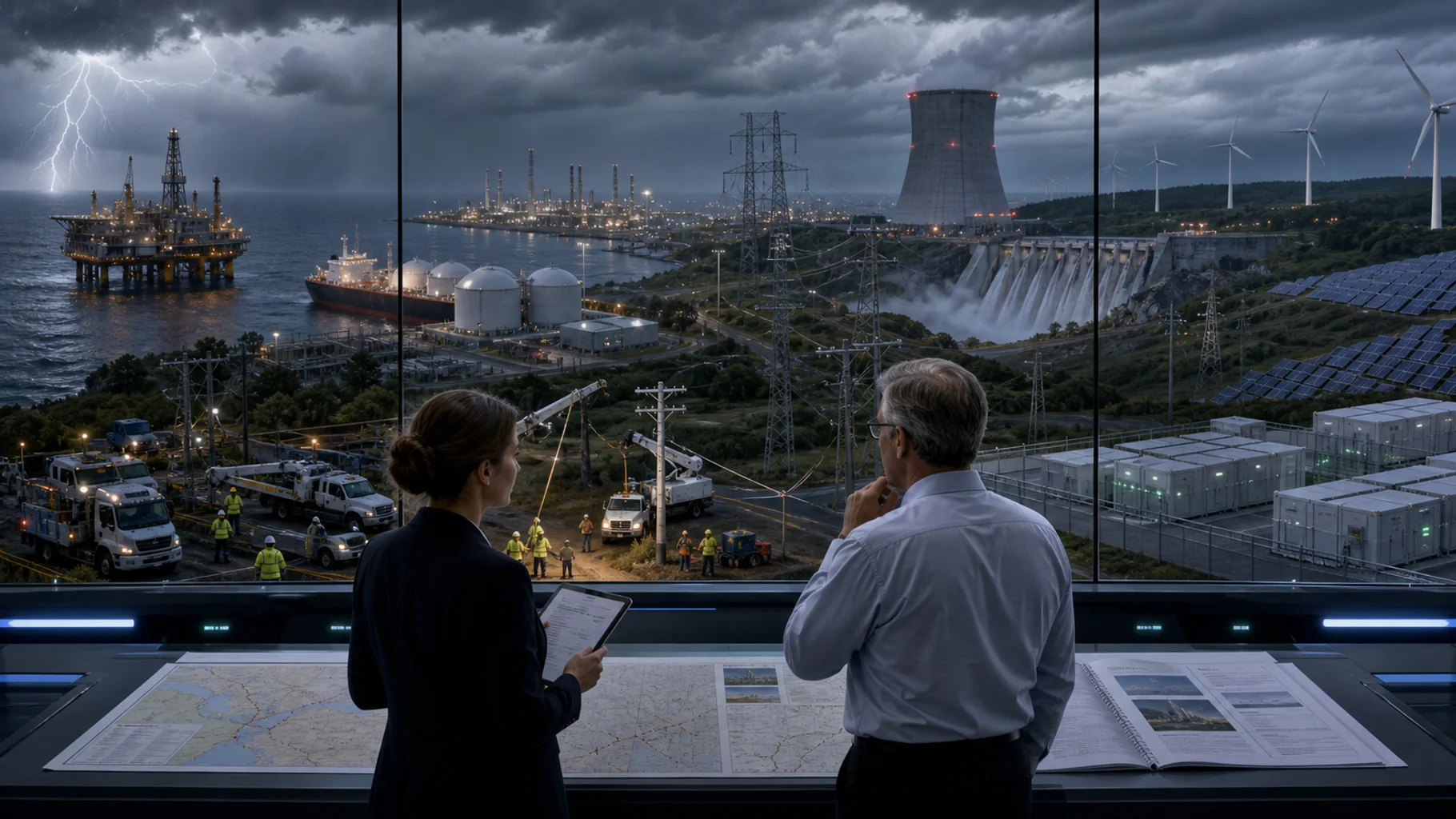
An investor and grid engineer examine a diversified energy network remaining operational through severe weather with active maintenance crews and redundant infrastructure.

Our Approach: The broad screening universe covers about 100,000 stocks; it is not the number of assets with published forecasts. For this edition, 376 assets passed preselection and underwent deep multi-agent analysis. iPulse AI Engine V6 ranked the top 10, and 10 Editorial Top Picks passed the separate evidence review and approval workflow. Read the detailed methodology

Editorial Picks countdown

Top 10 Editorial Picks

RELIANCE:NSEHQ:Listed:

Energy ยท Oil & Gas Refining & Marketing

Large Indian private sector company with businesses in energy, petrochemicals, textiles, retail, and telecommunications.

RatingBuy

Latest editorial review

Reviewed through 24 Aug 2026

Based on deep-analysis report: 5 Jul 2026 ยท newer evidence is included through the review date

Thesis remains current

Review conclusion

The latest editorial review continues to support the original investment case and current rating.

The editor's view

The original investment case and current rating remain supported as of 2026-08-24T15:12:25Z. The quarterly update refreshed energy, retail, digital, and capital-spending evidence without a thesis-breaking event. Monitor the next material filing, policy decision, protocol release, or operating update.

What to watch

A complete and prolonged closure of critical Middle Eastern maritime corridors would physically prevent crude delivery to the refining complex. The next material filing, operating update, policy decision, or protocol release for a change in the load-bearing thesis.

+79.0%
Excl. dividends: +76.4%
0.3%Dividend yield (net)
โ€”Buyback yield
23.7x
44/100
98/100

Flagship insight

Hidden Free Cash Flow Inflection Reshapes Digital and Energy Infrastructure Moats

There is high consensus that a structural free cash flow inflection and upcoming digital subsidiary public listings will drive a major valuation re-rating. While near-term maritime logistics disruptions pressure legacy refining margins, the transition to self-funded green energy and sovereign computing infrastructure secures long-term dominance.

The company is shifting from a heavy-spending builder of networks and stores to a massive cash-generating machine. For years, heavy spending on 5G networks and retail stores kept cash flows tight, but that building phase is now complete. The company is now harvesting steady cash from its dominant telecom and retail businesses, which easily funds its new green energy and artificial intelligence projects. This transition makes the business much safer and more profitable, even during global economic uncertainty, ensuring it remains a reliable long-term investment for everyday savers.

  • The end of heavy 5G network spending allows the company to keep much more of its cash.
  • Upcoming stock market listings for the digital and retail divisions will show their true, massive value.
  • New solar and battery factories will create clean energy revenues and protect against future fossil fuel declines.
  • Partnerships in artificial intelligence make the company the main landlord for technology infrastructure in the region.
  • High-tech oil refining facilities can process cheap crude oil, keeping profits high despite global shipping troubles.
  • A strong balance sheet with very low debt protects the company from high global interest rates.

Advisor consensus

Overall, advisors show very high price-direction agreement and low disagreement. Read on to see where advisor views still differ.

The primary disagreements across the reports center on the valuation multiples applied to the green energy division and the exact timing of the subsidiary listings. Some perspectives assume a rapid, high-multiple re-rating as soon as the first solar modules are commercialized, while others adopt a more conservative horizon, emphasizing near-term return on capital dilution from heavy capital intensity. Additionally, there is divergence regarding the persistence of geopolitical refining premiums, with some views treating elevated margins as a durable cash cushion and others modeling a swift mean reversion.

Risk and opportunity map

Longer-term opportunities

Standalone Retail Subsidiary Demerger and IPO

Capital Allocation

38% probabilityStock price impact: +20.0%Earnings impact: Not quantified

Following the digital listing, an accelerated announcement of a standalone public offering for the retail division would act as a massive secondary sum-of-the-parts catalyst. This would completely eliminate the conglomerate discount, allowing global consumer-focused funds to directly bid up the retail monopoly as a standalone entity.

Green Hydrogen Export and Cost Breakthrough

Innovation And Product

25% probabilityStock price impact: +18.0%Earnings impact: Not quantified

Achieving levelized cost parity for green hydrogen ahead of global competitors would transform the green energy division into a dominant global exporter. Driven by international decarbonization mandates, securing long-term sovereign offtake agreements would instantly de-risk the massive capital sunk into the renewable vertical.

Tail risks

Prolonged Maritime Blockade and Crude Supply Failure

Political And Geopolitical

25% probabilityStock price impact: -22.0%Earnings impact: Not quantified

A complete and prolonged closure of critical Middle Eastern maritime corridors would physically prevent crude delivery to the refining complex. This scenario would force devastating capacity shut-ins and destroy legacy cash flows, crippling the primary engine that funds the digital and green energy transitions.

Digital Subsidiary IPO Valuation Failure or Delay

Capital Allocation

22% probabilityStock price impact: -15.0%Earnings impact: Not quantified

Severe global liquidity tightening or market corrections could cause the highly anticipated digital subsidiary IPO to price significantly below expectations or face extended delays. This would shatter the primary near-term catalyst, forcing the market to re-apply a heavy conglomerate discount.


D:NYSEHQ:Listed:

Utilities ยท Multi-Utilities

Energy company producing and transporting energy with portfolio of electric generation, transmission, and natural gas storage.

RatingBuy

Latest editorial review

Reviewed through 24 Aug 2026

Based on deep-analysis report: 5 Jul 2026 ยท newer evidence is included through the review date

Thesis remains current

Review conclusion

The latest editorial review continues to support the original investment case and current rating.

The editor's view

The original investment case and current rating remain supported as of 2026-08-24T15:12:25Z. The quarterly results refreshed regulated earnings, capital spending, and financing evidence without breaking the stored utility thesis. Monitor the next material filing, policy decision, protocol release, or operating update.

What to watch

State or federal regulators could officially block the NextEra merger due to antitrust or ratepayer concerns. The next material filing, operating update, policy decision, or protocol release for a change in the load-bearing thesis.

+96.9%
Excl. dividends: +66.0%
3.5%Dividend yield (net)
โ€”Buyback yield
23.0x
34/100
75/100

Flagship insight

How Regulated Grid Monopolies Are Quietly Taxing The Global Artificial Intelligence Boom

High consensus exists regarding the asset's role as an indispensable physical bottleneck for artificial intelligence infrastructure expansion. While a restrictive macroeconomic regime pressures its leveraged balance sheet, the implementation of structured customer collateral tariffs and guaranteed rate-base compounding provides a robust, state-sanctioned cushion against cyclical headwinds.

This company is changing from a traditional power company into the essential electricity provider for the artificial intelligence boom. While many investors worry about the company's high debt and heavy spending, its unique position in Virginiaโ€”where most of the world's internet traffic is processedโ€”gives it guaranteed customer demand. New rules also force big tech companies to pay for their own power connections, protecting the company from financial risk.

  • The company has a legal monopoly over the region where major tech firms build their massive AI data centers.
  • New power contracts force tech giants to pay upfront cash deposits, protecting the company from losing money if plans change.
  • A major offshore wind project is nearly finished, which will soon lower fuel costs and start bringing in steady cash.
  • High interest rates make borrowing expensive, which is the main challenge for the company's heavy construction plans.
  • Tech companies might directly help fund new power lines and nuclear projects, reducing the company's need to borrow money.
  • Local residents might complain about rising electricity bills, which could lead to political pressure on power rates.

Advisor consensus

Overall, advisors show very high price-direction agreement and low disagreement. Read on to see where advisor views still differ.

The primary disagreement across the reports centers on the regulatory feasibility and ultimate outcome of the NextEra merger, alongside the standalone viability of the asset's balance sheet. Some perspectives view the merger as a highly probable, necessary capital rescue that is mathematically mandated to support the grid. Conversely, other assessments apply a heavy risk discount, anticipating a broken deal due to state-level political hostility. This divergence stems from differing assumptions regarding regulatory tolerance, the timeline of rate-base integration, and the speed at which hyperscaler collateral under the GS-5 tariff will relieve near-term cash flow pressures.

Risk and opportunity map

Longer-term opportunities

Hyperscaler Direct Grid Co-Investment

Sector And Industry

35% probabilityStock price impact: +25.0%Earnings impact: Not quantified

To bypass long interconnection queues, major technology hyperscalers could directly co-fund or pre-fund dedicated generation and transmission assets. This framework would shift the massive capital expenditure burden off the utility's balance sheet while allowing it to collect lucrative operational fees and transmission tariffs, transforming the business into a capital-light, high-return infrastructure platform.

SMR Nuclear Regulatory Fast-Track

Innovation And Product

25% probabilityStock price impact: +20.0%Earnings impact: Not quantified

National security imperatives to secure domestic artificial intelligence supremacy could compel federal regulators to fast-track the licensing and deployment of Small Modular Reactors. If the asset secures expedited approval and subsidies for nuclear expansion, it would unlock a highly profitable, zero-carbon baseload generation pipeline, driving a massive multiple re-rating.

Tail risks

Regulatory Merger Denial and Standalone Reset

Regulatory

30% probabilityStock price impact: -25.0%Earnings impact: Not quantified

State or federal regulators could officially block the NextEra merger due to antitrust or ratepayer concerns. This would instantly dissolve the merger arbitrage floor, forcing the asset to fund its massive capital pipeline standalone. The resulting capital strain would likely necessitate highly dilutive equity issuances or credit downgrades, triggering a severe downward repricing.

Populist Ratepayer Backlash and ROE Capping

Political And Geopolitical

25% probabilityStock price impact: -20.0%Earnings impact: Not quantified

Surging residential electricity bills driven by grid modernization costs could trigger intense political backlash. If the state legislature intervenes to protect voters by capping the allowed return on equity or delaying cost-recovery mechanisms, the fundamental link between capital expenditure and earnings growth would fracture, permanently impairing shareholder capital.

IBE:BMEHQ:Listed:

Utilities ยท Electric Utilities

Spanish multinational electric utility company with wind, renewable power, grid, and clean energy infrastructure operations.

RatingStrong Buy

Latest editorial review

Reviewed through 24 Aug 2026

Based on deep-analysis report: 5 Jul 2026 ยท newer evidence is included through the review date

Thesis remains current

Review conclusion

The latest editorial review continues to support the original investment case and current rating.

The editor's view

The original investment case and current rating remain supported as of 2026-08-24T15:12:25Z. The half-year results reinforced regulated-network investment and earnings evidence while financing and project execution remain important. Monitor the next material filing, policy decision, protocol release, or operating update.

What to watch

Restrictive monetary policy and persistent inflation could trigger a sovereign debt crisis in peripheral European markets, causing credit spreads to blow out. The next material filing, operating update, policy decision, or protocol release for a change in the load-bearing thesis.

+93.7%
Excl. dividends: +56.2%
4.4%Dividend yield (net)
โ€”Buyback yield
18.7x
35/100
79/100

Flagship insight

Why Global Compute Demands Are Quietly Transforming Regulated Grid Infrastructure Monopolies

There is high consensus that the intersection of artificial intelligence power demands and sovereign energy security mandates is structurally re-rating physical grid infrastructure. While elevated capital costs present near-term multiple compression risks, the long-term pricing power of transmission monopolies remains heavily underappreciated by the broader market.

The company is changing from a basic power company into a vital backbone for the artificial intelligence boom and national energy security. Even though high interest rates and heavy spending on new power grids are hurting short-term cash flow, the massive demand for clean electricity to run data centers guarantees long-term growth.

  • Artificial intelligence data centers require massive amounts of electricity, giving power grid owners strong pricing power.
  • Heavy spending on new power lines and renewable energy secures future profits but limits immediate cash payouts.
  • Governments are fast-tracking green energy projects to reduce reliance on foreign fossil fuels, helping speed up growth.
  • High interest rates make borrowing expensive, which could squeeze profit margins and keep the stock price volatile.
  • New business partnerships allow the company to own stakes in data centers, boosting profits beyond traditional power sales.
  • Political pressure to keep electricity bills low for consumers could lead to unexpected taxes or price limits.

Advisor consensus

Overall, advisors show very high price-direction agreement and low disagreement. Read on to see where advisor views still differ.

The primary disagreement across reports centers on the valuation multiple and the quality of earnings. Skeptical perspectives focus on a short-term horizon, arguing that the severe divergence between accounting net income and collapsing free cash flow indicates poor earnings quality, exacerbated by high debt levels in a restrictive rate environment. Conversely, optimistic views adopt a long-term structural horizon, asserting that heavy capital expenditures are building an unassailable physical monopoly. These reports assume that the massive demand from artificial intelligence data centers will allow the company to command premium pricing, easily offsetting elevated borrowing costs.

Risk and opportunity map

Longer-term opportunities

Hyperscaler Capex Subsidization

Capital Allocation

35% probabilityStock price impact: +20.0%Earnings impact: Not quantified

To secure exclusive power rights, a mega-cap technology entity could directly pre-fund or co-invest in the company's generation and transmission capital expenditures. This off-balance-sheet subsidization would eliminate debt-issuance risk, radically improve capital efficiency, and transform the company into a high-return toll bridge for global compute.

US Grid Permitting Override

Regulatory

25% probabilityStock price impact: +15.0%Earnings impact: Not quantified

Panicked by artificial intelligence compute capacity falling behind global rivals, the US government could utilize emergency federal powers to bypass state-level environmental permitting for transmission lines. This would compress decade-long project backlogs into months, rapidly accelerating rate-base compounding and front-loading multi-year earnings growth.

Tail risks

Sovereign Debt Crisis Contagion

Macroeconomic And Macrofinancial

25% probabilityStock price impact: -25.0%Earnings impact: Not quantified

Restrictive monetary policy and persistent inflation could trigger a sovereign debt crisis in peripheral European markets, causing credit spreads to blow out. As a highly leveraged entity reliant on continuous debt rollover to fund its capital expenditures, the company would face a sudden liquidity freeze, forcing dilutive equity issuance.

Decentralized SMR Proliferation

Innovation And Product

15% probabilityStock price impact: -20.0%Earnings impact: Not quantified

Rapid commercialization and regulatory approval of Small Modular Nuclear Reactors could allow hyperscalers and heavy industry to deploy localized generation directly adjacent to their facilities. This technological shift would bypass the macro transmission network entirely, stranding the company's grid assets and neutralizing its network monopoly.

051910:KRXHQ:Listed:

Materials ยท Commodity Chemicals

South Korean diversified chemical company producing petrochemicals, advanced materials, batteries for electric vehicles, and life sciences products.

RatingStrong Buy

Latest editorial review

Reviewed through 24 Aug 2026

Based on deep-analysis report: 5 Jul 2026 ยท newer evidence is included through the review date

Thesis remains current

Review conclusion

The latest editorial review continues to support the original investment case and current rating.

The editor's view

The original investment case and current rating remain supported as of 2026-08-24T15:12:25Z. The quarterly materials refreshed chemicals and battery-materials demand, margin, and capital-spending evidence without invalidating the original investment case. Monitor the next material filing, policy decision, protocol release, or operating update.

What to watch

If the electric vehicle slowdown intensifies and credit markets tighten, the company's negative free cash flow could breach debt covenants. The next material filing, operating update, policy decision, or protocol release for a change in the load-bearing thesis.

+132.0%
Excl. dividends: +129.0%
0.3%Dividend yield (net)
โ€”Buyback yield
Unavailable
35/100
41/100

Flagship insight

How Peak Capital Expenditure and Asset Monetization Will Trigger a Valuation Inflection

There is high consensus across reports that peak capital expenditure is rolling off, paving the way for a major cash flow inflection. While legacy petrochemical overcapacity remains a structural friction, strategic monetization of battery subsidiary equity provides a robust liquidity backstop, driving a powerful long-term operational turnaround.

The company is undergoing a major shift from a traditional chemical maker to a high-tech battery and advanced materials supplier. Right now, the stock is very cheap because the market is focused on heavy spending and a temporary slowdown in electric vehicle sales. However, this heavy spending phase is ending, and the company is about to start keeping more of the cash it generates. To fund this transition without taking on dangerous debt, the company is selling small parts of its highly valuable battery subsidiary. This strategy protects the business and sets it up for a strong recovery as new factories start producing.

  • The heavy spending phase is peaking, which will soon stop the cash drain and improve overall cash flow.
  • The company's massive stake in its battery subsidiary acts as a financial safety net to fund growth.
  • Traditional chemical businesses are struggling due to cheap competition, but the company is actively closing these weak areas.
  • Trade rules in the US and Europe protect the company's battery materials from cheaper Chinese competitors.
  • Investors are pushing management to return more cash to shareholders, which could boost the stock price.
  • The main risks are a slower-than-expected recovery in electric vehicle demand and high interest rates.

Advisor consensus

Overall, advisors show very high price-direction agreement and low disagreement. Read on to see where advisor views still differ.

The primary disagreement across the reports centers on the duration and volatility of the transition period. Some perspectives adopt a highly constructive outlook, anticipating a rapid valuation recovery driven by immediate activist-enforced restructuring and AI-driven materials growth. Conversely, more conservative analyses emphasize the severe near-term cash burn and deteriorating credit metrics, predicting a prolonged sideways chop. These differences stem from varying assumptions regarding the speed of the electric vehicle demand recovery and the execution timeline of legacy petrochemical asset divestitures.

Risk and opportunity map

Longer-term opportunities

Activist-Forced Capital Restructuring

Capital Allocation

35% probabilityStock price impact: +35.0%Earnings impact: Not quantified

If persistent undervaluation and activist pressure force management to accelerate the monetization of the battery subsidiary stake and direct the proceeds entirely to massive share buybacks and cancellations, the holding company discount would collapse, triggering a rapid and strong upward re-rating of the equity.

Solid-State Battery Commercialization

Innovation And Product

25% probabilityStock price impact: +45.0%Earnings impact: Not quantified

Successful early commercialization of proprietary solid-state battery materials or next-generation cathode technology would leapfrog existing liquid-electrolyte architectures. This breakthrough would grant the company a near-monopoly on next-generation energy storage IP, driving significant margin expansion and attracting a premium technology multiple.

Tail risks

Forced Dilutive Capital Raise

Capital Allocation

25% probabilityStock price impact: -45.0%Earnings impact: Not quantified

If the electric vehicle slowdown intensifies and credit markets tighten, the company's negative free cash flow could breach debt covenants. If the battery subsidiary stake cannot be monetized at favorable prices, management might be forced into a highly dilutive equity offering at distressed valuations, permanently destroying shareholder value.

Complete Battery Technology Displacement

Innovation And Product

20% probabilityStock price impact: -50.0%Earnings impact: Not quantified

A rapid global shift toward cheaper, alternative battery chemistries like sodium-ion or low-cost lithium iron phosphate could bypass the company's heavy investments in premium high-nickel cathode materials. This technological displacement would render newly built mega-factories as stranded assets, forcing massive write-downs.

FLNC:NASDAQHQ:Listed:

Industrials ยท Electrical Components & Equipment

Energy storage technology company providing grid-scale battery systems, software, and services for utilities and renewable developers.

RatingStrong Buy

Latest editorial review

Reviewed through 24 Aug 2026

Based on deep-analysis report: 5 Jul 2026 ยท newer evidence is included through the review date

Thesis remains current

Review conclusion

The latest editorial review continues to support the original investment case and current rating.

The editor's view

The original investment case and current rating remain supported as of 2026-08-24T15:12:25Z. Weak margins and project timing add friction, while the backlog supports the stored recovery scenario. The update is material to monitor but remains absorbable within the thesis. Monitor the next material filing, policy decision, protocol release, or operating update.

What to watch

If the company's severe free cash flow burn persists and revenue recognition is delayed by supply chain disruptions, the remaining liquidity buffer will be rapidly exhausted. The next material filing, operating update, policy decision, or protocol release for a change in the load-bearing thesis.

+272.0%
Model rating: Buy
โ€”Dividend yield (net)
โ€”Buyback yield
Unavailable
28/100
20/100

Flagship insight

Why the AI Infrastructure Boom is Creating a Dangerous Working Capital Trap

There is sharp divergence across reports regarding whether massive grid-scale storage backlogs can overcome severe transpacific shipping bottlenecks and negative cash flows. While the primary driver remains inelastic hyperscaler data center demand, the ultimate risk centers on a potential working capital crunch and dilutive financing.

The company is currently caught in a tug-of-war between two powerful forces. On one side, the massive boom in artificial intelligence and data centers is creating an urgent, non-stop demand for large-scale battery storage systems to keep power grids stable. On the other side, the company is burning through cash to buy inventory and build these massive projects, leading to a negative cash flow of $271 million over the past year. While the company has a massive $5.6 billion backlog of orders, getting these batteries shipped and installed is difficult due to global shipping delays and new import taxes. If the company can survive this cash squeeze and sell more of its high-margin grid management software, it has a bright future.

  • Huge demand from AI data centers provides a massive, long-term pipeline of future orders.
  • High cash burn and heavy spending on inventory create a risky short-term financial squeeze.
  • Global shipping bottlenecks and import tariffs could delay project completions and revenue.
  • Intense competition from cheaper overseas battery manufacturers limits the company's pricing power.
  • Strong backing from major industrial parent companies helps secure large contracts that smaller rivals cannot win.
  • Everyday investors should watch for positive cash flow and rising software sales as signs of a healthy turnaround.

Advisor consensus

Overall, advisors show high price-direction agreement with limited disagreement. Read on to see where advisor views still differ.

The primary disagreement across reports centers on the company's valuation multiple and near-term survival runway. Optimistic views frame the asset as a critical, mispriced AI infrastructure play trading at a deep discount to sales, arguing that the massive backlog and hyperscaler partnerships will rapidly drive positive cash flow. Conversely, skeptical perspectives emphasize the broken owner economics of a low-margin hardware assembler, warning that the severe free cash flow burn and rising debt levels will inevitably force highly dilutive equity financing before any software-driven margin expansion can materialize.

Risk and opportunity map

Longer-term opportunities

Direct Hyperscaler Prepayments and Funding

Capital Allocation

35% probabilityStock price impact: +50.0%Earnings impact: Not quantified

Desperate to secure grid-scale battery capacity for their AI data centers, major technology hyperscalers could bypass traditional utility procurement and directly contract with the company, providing massive upfront cash prepayments. This non-traditional funding would instantly resolve the company's working capital constraints, eliminate dilution risk, and trigger a rapid upward re-rating.

Next-Generation Chemistry Integration

Innovation And Product

25% probabilityStock price impact: +40.0%Earnings impact: Not quantified

The successful commercial integration of disruptive, non-lithium battery chemistries (such as sodium-ion or solid-state) into the company's modular platforms. This technological breakthrough would structurally decouple the company from lithium supply chain constraints and geopolitical tariffs, drastically lowering the levelized cost of storage and expanding the addressable market.

Tail risks

Forced Dilutive Capital Raise

Capital Allocation

40% probabilityStock price impact: -50.0%Earnings impact: Not quantified

If the company's severe free cash flow burn persists and revenue recognition is delayed by supply chain disruptions, the remaining liquidity buffer will be rapidly exhausted. Under restrictive credit conditions, the company would be forced to execute a highly dilutive secondary equity offering at depressed valuations, permanently impairing per-share intrinsic value.

Predatory Pricing War

Competitive Positioning

30% probabilityStock price impact: -40.0%Earnings impact: Not quantified

A vertically integrated competitor, leveraging massive manufacturing scale and a robust balance sheet, initiates a predatory pricing war in grid-scale storage to capture market share. Lacking captive cell manufacturing, the company would be forced to match prices, driving gross margins back into single digits and structurally breaking its path to profitability.

The leading five

The Top 5

#5 โ†’ #1

Five ideas remain. Each passed the full editorial review and earned a place in this edition's highest-conviction group.

LAC:NYSEHQ:Listed:

Materials ยท Diversified Metals & Mining

Lithium developer advancing North American lithium resources for battery supply chains and energy transition demand.

RatingBuy

Latest editorial review

Reviewed through 24 Aug 2026

Based on deep-analysis report: 5 Jul 2026 ยท newer evidence is included through the review date

Thesis remains current

Review conclusion

The latest editorial review continues to support the original investment case and current rating.

The editor's view

The original investment case and current rating remain supported as of 2026-08-24T15:12:25Z. The financing filing changes funding detail but can still be absorbed within the stored project-development thesis; dilution and construction execution remain central risks. Monitor the next material filing, policy decision, protocol release, or operating update.

What to watch

Severe inflationary pressures or engineering failures could cause construction costs to breach the funded upper bounds. The next material filing, operating update, policy decision, or protocol release for a change in the load-bearing thesis.

+250.0%
Model rating: Buy
โ€”Dividend yield (net)
โ€”Buyback yield
Unavailable
44/100
13/100

Flagship insight

How Sovereign Funding Moats Shield This Critical Mineral Developer From Dilution

High consensus across reports indicates that sovereign-backed funding structures have mathematically closed the developer's capital gap, shielding equity from further dilution. While near-term macroeconomic headwinds and high capital costs persist, the transition to commercial production by late 2027 remains the primary driver of long-term structural repricing.

This company is building a massive domestic lithium mine, which is a key ingredient for electric vehicle batteries and power grids. Right now, the company is spending heavily to build the mine, which has caused its stock price to drop due to fears of share dilution. However, the company has secured massive financial backing from the government and a major automaker, which fully funds the project. Once the mine is completed in late 2027, the company will transition from a cash-burning developer to a highly profitable producer. This transition will shift the market's focus from construction costs to steady future earnings.

  • Government loans and automaker investments have fully funded the construction of the mine.
  • The stock is currently cheap because the market is focused on short-term spending rather than long-term value.
  • Share dilution from recent stock sales will slow down as the project nears completion.
  • The mine will benefit from a protected domestic market, shielding it from global price drops.
  • Building a large chemical processing plant carries risks of delays and cost overruns.
  • Growing demand for power grid batteries to support AI data centers provides a new growth path.

Advisor consensus

Overall, advisors show very high price-direction agreement and low disagreement. Read on to see where advisor views still differ.

The primary disagreements across the reports center on the near-term price path and the severity of execution risks. Some perspectives advocate for a highly cautious stance, emphasizing that ongoing equity dilution and high interest rates will keep the stock suppressed through mid-2027. Conversely, other reports adopt a more aggressive accumulation stance, arguing that the sovereign backstop and strategic partnerships have already established an ironclad valuation floor, making current distressed prices an asymmetric buying opportunity. There is also minor divergence regarding the potential for clay extraction scaling delays.

Risk and opportunity map

Longer-term opportunities

Strategic Takeover by Major OEM or Miner

Competitive Positioning

25% probabilityStock price impact: +70.0%Earnings impact: Not quantified

A major automaker or global mining conglomerate could acquire the remaining stake in the company outright to secure a fully permitted, domestic critical mineral supply chain. A buyout premium would instantly close the valuation gap, rewarding equity holders who survived the dilution phase.

Direct Government Grant Conversion

Regulatory

15% probabilityStock price impact: +50.0%Earnings impact: Not quantified

Under escalating national security mandates, the federal government could restructure portions of the outstanding loan into non-repayable grants or offer massive operational tax credits. This would instantly repair the balance sheet, wiping out future interest obligations and boosting net present value.

Tail risks

Severe Capex Cost Blowout

Operational Efficiency

25% probabilityStock price impact: -50.0%Earnings impact: Not quantified

Severe inflationary pressures or engineering failures could cause construction costs to breach the funded upper bounds. This would trigger a liquidity crisis, forcing management to execute highly punitive, distressed equity raises at depressed prices, permanently impairing the common equity.

Alternative Battery Chemistry Disruption

Innovation And Product

15% probabilityStock price impact: -60.0%Earnings impact: Not quantified

Rapid commercialization of sodium-ion or solid-state battery chemistries that require significantly less lithium could permanently degrade the long-term demand curve. If automakers pivot away from lithium-ion architectures, the terminal value of the mine would collapse, leaving it as a stranded asset.

VST:NYSEHQ:Listed:

Utilities ยท Independent Power Producers & Energy Traders

Integrated power generation and retail electricity company with strong exposure to merchant power pricing and rising AI-driven load growth.

RatingStrong Buy

Latest editorial review

Reviewed through 24 Aug 2026

Based on deep-analysis report: 5 Jul 2026 ยท newer evidence is included through the review date

Thesis remains current

Review conclusion

The latest editorial review continues to support the original investment case and current rating.

The editor's view

The original investment case and current rating remain supported as of 2026-08-24T15:12:25Z. The quarterly update refreshed power-market, earnings, and capital-allocation evidence without breaking the stored electricity thesis. Monitor the next material filing, policy decision, protocol release, or operating update.

What to watch

A catastrophic grid failure or prolonged power crunch leads to severe public backlash over soaring consumer electricity bills. The next material filing, operating update, policy decision, or protocol release for a change in the load-bearing thesis.

+117.0%
Excl. dividends: +111.0%
0.5%Dividend yield (net)
โ€”Buyback yield
20.9x
27/100
72/100

Flagship insight

Why Thermodynamic Constraints Are Creating a Monopolistic Toll Bridge for Power

A high consensus across reports highlights this asset as a premier thermodynamic bottleneck for artificial intelligence scaling. While robust domestic energy security and deregulation extend legacy asset lifespans, substantial balance sheet leverage and elevated refinancing costs present persistent friction under a restrictive monetary regime.

The company is in a unique position because tech giants need massive amounts of reliable, round-the-clock electricity to power their new artificial intelligence data centers. Since wind and solar power are too intermittent, the company's nuclear and natural gas plants have become highly valuable, scarce resources. This allows the company to sign long-term, high-priced contracts with major tech firms, turning a traditional power company into a highly profitable technology infrastructure provider. While the company carries a lot of debt, its strong cash generation and steady share buybacks protect its long-term value.

  • Tech companies are willing to pay high premiums for reliable nuclear and gas power to keep their AI systems running.
  • Government deregulation is allowing older gas and coal plants to run longer and cheaper, boosting short-term cash flows.
  • The company is using its massive cash flows to buy back its own stock, which steadily increases the value for remaining shareholders.
  • High debt levels mean that rising interest rates will increase refinancing costs and eat into some profits.
  • Physical delays in upgrading the electrical grid and getting equipment like transformers could slow down new project connections.
  • Extreme weather events like severe freezes or heatwaves can temporarily disrupt operations and force expensive power purchases.

Advisor consensus

Overall, advisors show very high price-direction agreement and low disagreement. Read on to see where advisor views still differ.

The primary disagreement across reports centers on the sustainability of the asset's valuation multiple and the timeline for cash-flow realization. Cautious perspectives argue that the current stock price reflects an unsustainable tech-like multiple on a business still bound by regulatory and physical grid constraints, warning of multiple compression as the reflexivity cycle reverses. Conversely, bullish views assert that the market continues to underprice the absolute scarcity of dispatchable baseload power, expecting rapid re-rating as long-term contracts convert into highly visible, predictable cash flows.

Risk and opportunity map

Longer-term opportunities

Hyperscaler Co-Location Joint Venture

Competitive Positioning

40% probabilityStock price impact: +35.0%Earnings impact: Not quantified

A major technology monopoly executes a massive, multi-decade joint venture to fully fund and co-locate a next-generation AI datacenter directly behind the meter at a nuclear site. This would instantly eliminate grid transmission bottlenecks and permanently re-rate the stock to a premium tech-infrastructure multiple.

Federal Sovereign AI Infrastructure Designation

Regulatory

25% probabilityStock price impact: +25.0%Earnings impact: Not quantified

The federal government formally designates the baseload nuclear fleet as critical sovereign AI infrastructure to counter geopolitical tech competition. This would unlock direct federal subsidies, guaranteed low-cost loans, and immunity from state-level price caps, embedding a massive risk premium into the asset base.

Tail risks

Populist Price Controls and Windfall Taxes

Regulatory

25% probabilityStock price impact: -30.0%Earnings impact: Not quantified

A catastrophic grid failure or prolonged power crunch leads to severe public backlash over soaring consumer electricity bills. Regulators or state legislatures intervene to impose strict wholesale price caps or windfall profit taxes, structurally destroying the company's ability to capture scarcity pricing premiums.

Hyperscaler PPA Renegotiation via AI Failure

Competitive Positioning

20% probabilityStock price impact: -35.0%Earnings impact: Not quantified

A systemic failure of enterprise AI monetization forces hyperscalers to aggressively break or renegotiate their long-term power purchase agreements. The company would be left holding over-capitalized baseload assets in an oversupplied wholesale market, leading to severe multiple compression.

The finalists

The Top 3

#3 โ†’ #1

The shortlist is over. These three stocks earned the strongest conviction in this edition. Count down to the research team's number-one pick.

Checking your access...

The winner

The Number-One Pick

The edition's highest-conviction selection, combining near-term opportunity with long-term confirmation.

Market context and selection approach

Power demand, grid investment, commodity exposure, permitting, capex, financing, and policy support shape the opportunity across these different energy areas.

Selections use only governed energy eligibility and preserve candidate order after current checks of projects, contracts, inputs, grid access, financing, and policy risk.

References

Frozen links are separated into editorial-review evidence, 5โ€“6 global-context references, and 3โ€“4 governed Researcher citations per selected asset. Duplicate URLs appear once; the combined citation list is capped at 30.

A. Editorial-review sources

  1. 1.Integrated Financial Filing for the Quarter Ended June 30, 2026 National Stock Exchange of India ยท EXCHANGE NOTICE ยท 5 Aug 2026, 00:00 UTChttps://nsearchives.nseindia.com/corporate/ixbrl/INTEGRATED_FILING_INDAS_182975_05082026230017_iXBRL_WEB.htmlReviewed for: Power Grid Corporation of India Limited (POWERGRID.NSE)
  2. 2.Nextpower Reports Q1 Fiscal Year 2027 Financial Results Nextpower Inc. ยท ISSUER RELEASE ยท 30 Jul 2026, 00:00 UTChttps://investors.nextracker.com/news/news-details/2026/Nextpower-Reports-Q1-Fiscal-Year-2027-Financial-Results/default.aspxReviewed for: Nextracker Inc. (NXT.NASDAQ)
  3. 3.ENGIE 2026 First-Half Financial Results ENGIE SA ยท ISSUER RELEASE ยท 31 Jul 2026, 00:00 UTChttps://www.engie.com/en/investors/financial-publicationsReviewed for: Engie SA (ENGI.PAR)
  4. 4.Vistra Reports Second Quarter 2026 Results Vistra Corp. ยท ISSUER RELEASE ยท 7 Aug 2026, 00:00 UTChttps://investor.vistracorp.com/2026-08-07-Vistra-Reports-Second-Quarter-2026-ResultsReviewed for: Vistra Energy Corp (VST.NYSE)

B. Global market context

These dated files capture broader market, macroeconomic, policy, and cross-asset context. Each frozen file is supplied as input to every advisor model during deep analysis; its citations never count toward an asset-specific minimum.

  1. 5.Federal Reservehttps://www.federalreserve.gov/monetarypolicy/fomccalendars.htm
  2. 6.US Bureau of Labor Statisticshttps://www.bls.gov/cpi/data.htm
  3. 7.US Bureau of Economic Analysishttps://www.bea.gov/data/gdp/gross-domestic-product
  4. 8.US Treasuryhttps://home.treasury.gov/resource-center/data-chart-center/interest-rates
  5. 9.US Energy Information Administrationhttps://www.eia.gov/
  6. 10.Reuters Worldhttps://www.reuters.com/world

C. Asset-specific deep-analysis sources

Captured by governed AI Researcher agents. Shared URLs are shown once and identify every selected asset they support.

Asset-specific Researcher citations remain available in each linked deep analysis above; this original edition did not add a second citation set.

Important information

Research scope and investor notice

Research scope

  • External evidence was limited to material current-event validation through the frozen cutoff; the underlying complete-batch analysis was not rerun.
  • Forecasts, ratings, ranks, returns, financial-health values, and risk values remain frozen and may not capture later events.
  • The named human editor reviewed the evidence and approved this edition for publication. Readers should inspect the cited sources and apply independent judgment.

Investor notice

AI-assisted editorial research for informational and educational purposes. This edition was reviewed and approved by a named human editor. It is not personalized investment advice or a promise of future performance.

Forecasts, ratings, and return estimates are uncertain and may change as new evidence becomes available.